
FP69/Practice List Cleansing/Revalidation/Ghost Patients
Important Update June 2026 – “List Cleansing”
The following was shared by BMA/GPC in their LMC update of 19th June 2026:
“Across England, practices are witnessing an unprecedented acceleration in patient list cleansing. What might appear to be a routine administrative exercise has rapidly become one of the most significant financial and operational challenges facing general practice this year.
Over the past six months alone, GP practice lists have fallen by 344,000 patients. At current Global Sum rates, that represents more than £40 million removed from core general practice funding at a time when practices are already operating on razor-thin margins.
As Dr Helen Salisbury recently observed in the BMJ, “While no one argues that practices should be funded for patients who have genuinely moved away, the consequences of large-scale list reductions cannot be ignored. These deductions translate directly into lost clinical capacity, reduced staffing flexibility and increased financial instability.”
The current exercise differs from previous list validation programmes in both scale and speed. Writing to Primary Care Minister Stephen Kinnock last week, GPCE have expressed serious concerns that patients are now being given just three months to respond before removal, rather than the six months traditionally allowed. The result is not only a more abrupt financial shock for practices, but also a heightened risk that vulnerable patients are incorrectly removed from their registered GP.
Those most likely to be affected are often those least able to navigate administrative processes: older people, patients with learning disabilities, those with limited English proficiency, and individuals with unstable housing arrangements. Many may never receive correspondence, may mistake it for a scam, or simply fail to appreciate the consequences of not responding. Meanwhile, practices are having to scrutinise hundreds of proposed deductions, creating a substantial additional administrative burden. Time and resources that should be focused on patient care are instead being diverted into checking lists and attempting to prevent inappropriate removals.
The profession is entitled to ask some difficult questions. What assessment was undertaken of the impact on vulnerable patients and health inequalities before this programme was accelerated? Why was the response period shortened? And perhaps most importantly, where is the funding going? The money removed through list cleansing is core GMS funding. If patient lists are being corrected, then the corresponding resources should be transparently recycled back into Global Sum so that funding continues to follow patient need. Yet GPC England has received little clarity about whether these savings will be reinvested in general practice.
Accurate patient data matters, but so does patient safety, practice stability and public trust. At a time when general practice is being asked to deliver more than ever with finite resources, list cleansing cannot become a backdoor mechanism for reducing investment in frontline care. GPCE will continue to press for urgent discussions with government and NHS England on the impact of this exercise and to seek assurances that both patients and practices are protected from unintended harm.”
Read the ‘focus on’ guidance on patient list cleansing
Read about the 26/27 contract changes and the BMA dispute with Government
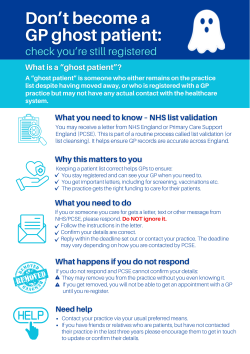
What is a “Ghost” Patient?
A “ghost patient” is someone who either remains on the practice list despite having moved away, or who is registered with a GP practice but may not have any actual contact with the healthcare system.
GP List Reconciliations
We believe there are two processes that PCSE administer on behalf of NHSE:
- List reconciliation (there are two elements to this which are described below)
- Rolling list maintenance
List reconciliation has two elements. The first operates on a continuous 3-year cycle. This means a third of all practices in England are formally requested to validate and reconcile their lists each year. PCSE will send a list for practices to check, which the practice completes and returns to PCSE. Where there are differences, practices then receive guidance from PCSE as how to manage these. We don’t believe when looking at the information provided an FP69 flag would be initiated in this process.
The second is a process that sits across the year which looks at the following six cohorts:
| Cohorts | Timeframe |
| Patients aged over 100 | 6 monthly – March & September checks |
| Patients that migrated to England one year ago (transient) | Monthly |
| Patients registered at an educational facility for four or more years (students) | Annually October to December |
| Properties the Royal Mail report as demolished (demolished properties) | Quarterly |
| Properties with eight or more registered inhabitants (multiple occupancy) | After the initial month, PCSE will check the additional patients who appeared at MO addresses and reset) |
| Patients not seen by general practice in previous 5 years | Annually |
Some of these may initiate an FP69 flag.
Rolling list maintenance is a process for managing mail that has been undelivered, or where a patient doesn’t respond to a request to confirm their address. The letters relate to national cancer screening or where a patient has registered for the first time with the NHS, which are sent by PCSE. If either the national cancer screening or the new patient letters are undelivered or the patient doesn’t confirm their address, an FP69 flag will be applied. Practices have 3 months to review whether the address is correct and then take the appropriate action.
Full details of the PCSE list reconciliation process (first element) can be found here. More detailed guidance can also be found in the NHS England » Primary medical services policy and guidance manual (PGM) (this sits under chapter 3 – Managing Patient Lists)
FP69s
FP69s are flags set on patients Personal Demographic Service (PDS) record, also referred to as Spine. They are set when:
- PCSE receive notification of mail that has been returned undelivered.
- A patient has failed to respond to a request to confirm their details, often as part of a patient list inflation exercise.
When an FP69 flag is applied to a patients record in PDS, a notification is sent to the relevant GP practices clinical system via GP Links on the day the flag is set.
From this date practices have three months (or six months, if the flag was set before 1 October 2025) to contact the patient and confirm their address information.
If no response is received after the three-month period and the patient is over the age of 18, they will be deducted. If the patient is under 18, no deduction will take place for safeguarding reasons, however, checks should still be made to ensure the correct address information is held.
Find out more about the FP69 flag process here.
If you have any further queries, please refer to the PCSE FAQs on FP69 flags here. If you cannot find the answer to your query you can email the PCSE Registrations team at pcse.registrations-preston@nhs.net
Other useful resources
BMA – Practice list validation
‘Ghost patients’ is a records management issue, says RCGP
*With special thanks to Londonwide LMCs who developed the original concept for the patient facing communications.