
Introduction
Spirometry is an essential investigation to diagnose and assess in people with COPD and other respiratory problems. There are significant variations in care and outcomes within the UK and internationally and COPD accounts for: –
- around 130,000 emergency hospital admissions each year.
- 1,151,474 people in England have been diagnosed with COPD
- It is thought that 2 million have COPD in the UK and have not yet been diagnosed
- Spirometry is one of the main investigations for diagnosing respiratory disease including asthma, and COPD.
- 1:5 people in the UK are affected by respiratory disease (ARTP 2021)
- See NICE and Asthma + Lung UK websites for more information
Spirometry – Restarting Diagnostic Testing in Primary Care
On April 29th, 2021, PCRS, ARTP and BTS updated their guidance. The document offers “practical advice on reinstating spirometry, who should carry it out, when and where it should be performed; it looks at the latest evidence on infection control and provides pointers on how to deal with the backlog of patients.”
Infection control measures
Spirometry is not considered to be an aerosol generating procedure (AGP). However, spirometry-associated cough has the potential to generate aerosol droplets necessitating a mitigation strategy which may include:
- All tests must be performed using a single use antibacterial antiviral filter
- The spirometer must be cleaned between patients per manufacturer’s COVID specific instructions.
- As a minimum this should involve cleaning the outer casing of the transducer and the outer part of the spirometer itself with alcohol wipes.
- Unless the patient is considered high risk for any reason, operators will need Personal Protective Equipment (PPE) consisting of gloves, apron, visor and Type IIR (surgical) mask.
- A Perspex screen between patient and operator offers an additional physical barrier for protection.
- If available, use a room with mechanical air circulation or ventilate as able (e.g. open windows).
- Ideally this should be in the region of 6 room air changes per hour.
- Other options that may be considered depending on the local situation include a drive through service or virtual spirometry.” ( pg.5 )
The document also discusses the pros and cons of this type of diagnostic testing being delivered at a PCN or practice level. The full document can be accessed via this link.
The Primary Care Respiratory Society (PCRS) has also published some practical guidance for clinicians and commissioners on recovering after Covid 19.
In July 2021 the ARTP published information on ventilation requirements for clinical areas to minimise Covid 19 transmission. (ARTP)
“Improving the Quality of Diagnostic Spirometry in Adults”
 In September 2016 a competency framework was published ” Improving the Quality of Diagnostic Spirometry in Adults ”
The document is quite detailed and we would encourage anyone involved in Spirometry and COPD to have a read. The document is a collaboration between the ARTP and:
- Education for Health
- Association of Respiratory Nurse Specialists
- Asthma & Lung UK
- British Thoracic Society
- Primary Care Respiratory Society UK
The document looked at the establishment of a national register of ‘certified healthcare professionals and operators.’ The objective is to ensure that staff operating, performing and/ or interpreting diagnostic spirometry hold a valid and current certificate of competency. We would recommend that you also read PCRS BTS/PCRS Joint position statement integrated care 2024
Spirometry Register
To be deemed competent to interpret spirometry health care professionals will need to be named on the Association for Respiratory, Technology and Physiology (ARTP) Register ( ARTP FAQs) They will be required to complete the Full Certificate in Spirometry or have completed a Foundation Certificate, topped up with the Interpretation module or gained entry to the register as an experienced practitioner. This is not yet a mandatory requirement but is deemed as best practice. The BMA also has guidance which confirms that currently there are no mandatory training requirements for performing spirometry.
“All individuals on the Spirometry Register have previously been required to successfully submit a portfolio of evidence every three years to continue with their spirometry registration. However, as the National Register is being hosted by the Academy for Healthcare Science, ARTP has changed how individuals will keep their registration valid. (ARTP Re-certification)
In line with other healthcare registers, individuals on the National Spirometry Register will be required to do the following to remain registered:
1) Complete an annual declaration of maintaining competency in their spirometry certification (User_Guide_to_Recertification.pdf)
2) Pay a £40 annual recertification fee (payment is by card only)
3) If selected to be part of the audit process, submit a portfolio of evidence demonstrating quality assured spirometry in their certification level. See further information below.
Individuals whose Spirometry Certificate has recently expired will now have been invited to renew, if you have not received your invitation please contact spirometry-register@artp.org.uk.
Invitations to renew are emailed out 3-4 weeks prior to the certificate expiry date. To avoid missing your email invitation and further updates, please ensure the following email address is added to your safe senders list: spirometry-register@artp.org.uk”
Having Your Name on the Register
If you have been performing diagnostic spirometry for several years you will not necessarily have to undergo any further training to have your name placed on the register. The Experienced Practitioner Scheme enables experienced individuals to undertake an assessment of competence without attending any specific training. You will need to re-register every 3 years.
The following are useful links that should address any questions you may have around the guidance: Education For Health ; ARTP FAQs ; Inspiring best practice in respiratory care | Primary Care Respiratory Society
Implementation of the Recommendations
ARTP – Association for Respiratory Technology & Physiology
To allow enough time for the necessary training, assessment and certification infrastructure to be set up, it was proposed to phase the implementation of the recommendations over the four-year period from 1 April 2017 – 31 March 2021. The date was extended due to Covid. Covid-19 Considerations (artp.org.uk)
CQC Views
(Last updated: April 2023 – CQC Mythbuster 83: Spirometry in General Practice)
This is taken directly from the CQC website April 2023 where information is shared about quality standards and best practice in spirometry and what they expect to see in an inspection. GP mythbuster 83: Spirometry in general practice | Care Quality Commission (cqc.org.uk)
Spirometry Certification
(Taken directly from the ARTP website)
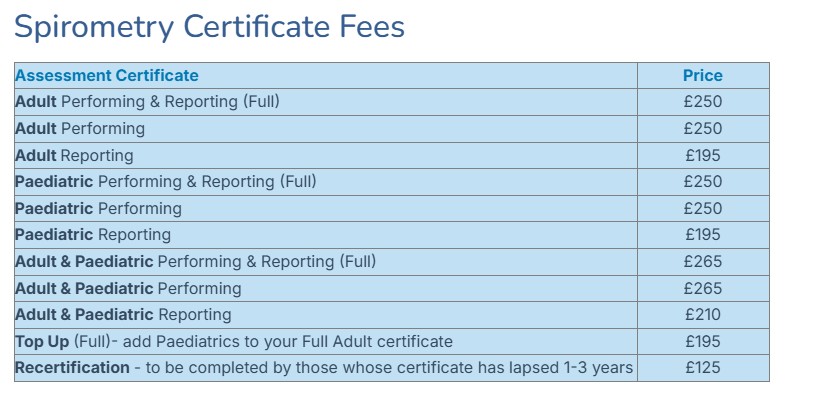
Please note the certificates do not include the cost for training
Training
There are several organisations who offer training via; modules, e-Learning, webinars, online and face to face study days. Please refer to their website for costs associated with both training and fees for portfolio assessment and ARTP registration.
New Candidates
If you are new to spirometry or your training is more than 3 years old, it is highly recommended that you book onto a training course to ensure your practice is up to date. Training is provided by many organisations and whatever training you choose to undertake, you are still eligible to apply to undertake the ARTP certificate of competence (assessment) which leads to being on the National Register, after you have completed your training.
Experienced Practitioner
If you are an experienced spirometry practitioner who needs to get onto the spirometry register, you may not need a training course. ARTP would recommend that you have received training within the last 3 years, and if you feel that you have sufficient experience, please proceed with your spirometry certificate (assessment) booking here. However, if you fail the assessments you will have the recommendation to book onto an external training course before progressing and you will be charged a rebooking fee for the failed assessment.
Booking onto a ARTP Spirometry Certificate
There are 3 different certificate levels that can be complete to gain access to the ARTP National Spirometry register. The most appropriate certificate for you depends on how and where you will use spirometry. For more information on each certificate click here. Please note these certificates do not include training and are for the assessment only. (Spirometry Assessment Certificates | ARTP Spirometry)
- ARTP – Training & Development
- Education for Health – COPD
- Rotherham Respiratory Ltd – Course Portfolio
- BMJ Learning – Spirometry in practice online course
You are also advised to contact: –
- your local training hubs:
- Nursing in Primary Care – Working across Wessex
- bswtraininghub.nhs.uk – Training Hub
Other Useful Links
-
- ARTP Spirometry FAQs
- NICE Overview | Chronic obstructive pulmonary disease in over 16s: diagnosis and management | Guidance | NICE
- BMA https://www.bma.org.uk/advice-and-support/gp-practices/gp-service-provision/spirometry-in-general-practice
- Primary Care Respiratory Society – your essential guide to spirometry Layout 1 (pcrs-uk.org)
- NEW – Update on spirometry guidance | Primary Care Respiratory Society (pcrs-uk.org)