
Introduction
Clinical Negligence Scheme for General Practice – (CNSGP)
From 1st April 2019, NHS Resolution has been operating a new state-backed indemnity scheme for general practice in England called the Clinical Negligence Scheme for General Practice (CNSGP) and everyone working in general practice will be automatically covered in relation to NHS services.
No payments are required to benefit from the indemnity provided under the scheme and there is no formal membership or other registration requirements for either individuals or practices/organisations.
The indemnity provided under the scheme continues to apply where a GP or other person is no longer practicing or working in general practice at the time a claim is made (which can be many months, sometimes years, after the clinically negligent act or omission occurred).
NHS Resolution will work hand in hand with those who find themselves the subject of a claim and only settle cases where compensation is due, while defending the rest. CNSGP is a comprehensive scheme available to all GPs whether in GMS, PMS, APMS and other settings and GPs should be confident they are fully covered just as clinicians in secondary care are
Full details of the scheme, which is being run by NHS resolution, can be found on their website at: Clinical Negligence Scheme for General Practice (CNSGP) – NHS Resolution.
NHS Resolution outlines its primary care offer including providing a brochure entitled Supporting Primary Care (March 2023).
If you are carrying out an activity that consists of, or is in connection with, the provision of primary medical services under a GMS, PMS or APMS contract, any clinical negligence liability incurred by you which arises from that activity is covered under the scheme.
If you are carrying out an activity that is not being delivered under the above contracts, you will be covered by the scheme if the answer to all the following questions is affirmative:
- Are you carrying out an activity that consists of, or is in connection with, the provision of NHS services?
- Are those NHS services being provided by, or under a contract with, a person or organisation whose principal activities are to provide primary medical services (i.e. the NHS services are provided as part of general practice)?
- Is the activity in question connected to the diagnosis, care or treatment of a patient?
Who is Covered?
- General Medical Services (GMS)/Personal Medical Services (PMS)/Alternative Provider Medical Services (APMS) contract-holders;
- GPs and other healthcare professionals (e.g. pharmacists, nurses, physiotherapists);
- All GP practice employees (including management, reception and administrative staff);
- Locums and self-employed workers;
- Trainees.
Safeguarding Reports
The BMA have issued the following statement :-
Following further discussions on some of the finer definitions of the scope of CNSGP, we are pleased to announce that it has been agreed with DHSC and NHS Resolution that the compiling of safeguarding reports for NHS patients will now be included within scope. It was initially thought that as these reports can be chargeable under collaborative fees arrangements they should be deemed to be private work and therefore out of scope. However, lobbying from the BMA extended an alternative view of these statutory reports as being reimbursed by the system rather than a private service to patients. This perspective has been accepted by DHSC and NHSR and therefore actions originating from the completion of safeguarding reports after 1st April 2019 will be covered by CNSGP.
What Activities are not Covered by CNSGP?
CNSGP does not cover all general practice activities.
In addition to retaining the management of existing claims, and being involved in any run off cover, Medical Defence Organisations MDOs or other indemnity providers will continue to provide members with advice and support on all non-NHS claims issues. The following circumstances will not fall within CNSGP include:
- Any healthcare delivered otherwise than through the NHS or local authority funded contracts for NHS public health services. This includes privately funded work undertaken by GPs and other primary care health professionals working in GP practices;
- Other non-NHS activities such as reports and medicals undertaken by GPs for other departmental bodies and insurance work, which falls outside of essential services;
- NHS primary care dentistry and private practice dentistry, other forms of privately-funded primary healthcare, community pharmacy and optometry;
- Medico-legal services (other than those directly relating to clinical negligence claims), such as representation at inquests or in relation to professional regulation matters;
- Claims for breach of confidentiality (due to wrongful disclosure of personal data) causing personal distress only. (See NHS (CNSGP) Regulations Section 5(1)(a) ).
- The following activities, unless they are being delivered under primary medical services contracts or are NHS ancillary health services under CNSGP:
- Voluntary activities (including Good Samaritan/Good Neighbour acts) and overseas work;
- Healthcare commissioned and provided by the Ministry of Defence; and GPs engaged by the Department for Work and Pensions (DWP) (except for completion of DWP forms required under a GMS contract which are in scope and therefore covered).
Please refer to the Scheme Scope document for detailed guidance on what falls within and without the scope of CNSGP.
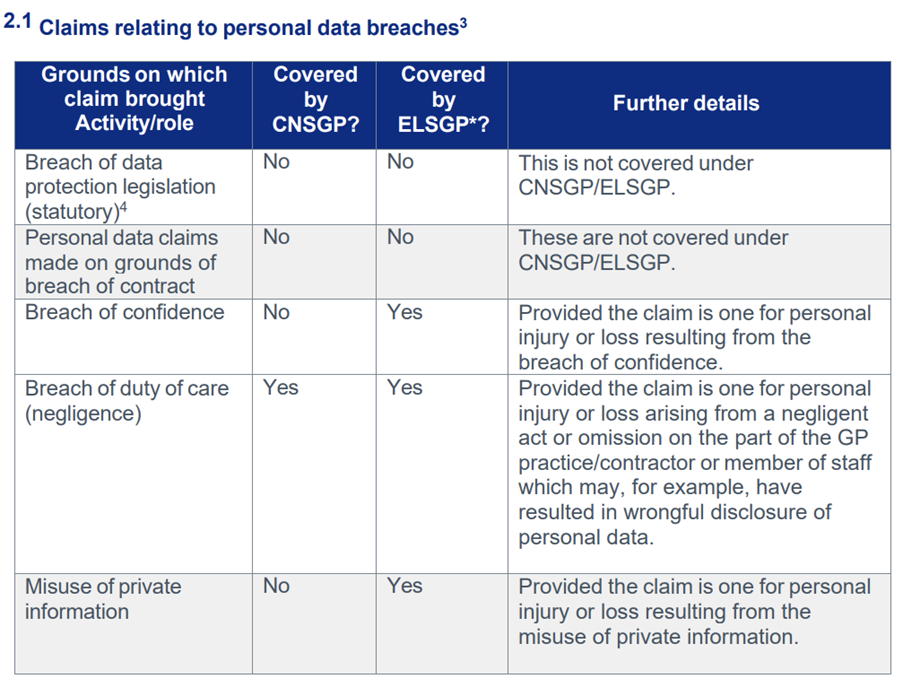
3.Please note that the scope table (CNSGP) published in February 2020 initially included an entry “Breach of Confidentiality (due to wrongful disclosure of personal data)” which stated that cover under CNSGP would apply where an alleged breach of confidence had occurred due to wrongful disclosure of personal data, resulting in personal injury or loss to a patient arising from or in connection with their diagnosis, care or treatment’. This entry was removed in later versions as the tort of breach of confidence, which applies a different legal test, is not within scope of CNSGP. The CNSGP only applies to ‘any liability in tort … that arises as a consequence of a breach of a duty of care …’ and which meets the other criteria set out in regulation 5(1) of the CNSGP Regulations. Breach of confidence is a tort, but unlike negligence, it does not involve the breach of a duty of care.
4. Personal data breaches: a guide | ICO
You will need to maintain membership with an MDO or other indemnity provider in respect of activities and services not covered by CNSGP.
So CNSGP will cover any clinical negligence liability incurred by your practice team which arises from services delivered on the NHS but it won’t provide the additional advice and guidance/support that the MDOs detail above. It is this that the MDOs are charging you for.
The MDOs have taken a view on assessing risk of a GP needing to use their services based on the types of NHS work that they are undertaking and set their new premiums accordingly.
Other Healthcare Professionals (ANPs, Nurses, HCAs, Paramedics etc)
We would encourage practices to clarify with their MDO what cover is included for ancillary staff that is not provided by the CNSGP. It may be necessary for these individuals (ANP, Nurses, HCAs Paramedic’s etc) to obtain cover for professional representation and additional indemnity cover for any private work they are undertaking on behalf of the practice.
Important Links
MDU https://www.themdu.com/ .
MPS https://www.medicalprotection.org/uk/home
MDDUS https://www.mddus.com/
NHS Resolution https://resolution.nhs.uk/
RCN Indemnity Scheme – https://www.rcn.org.uk/indemnity
Useful resources:
NHS Resolution – support for healthcare staff Support for healthcare staff – NHS Resolution
Wessex LMC Support – Support – Wessex LMCs